Modular Drug Architecture · AMDC

治療抵抗性進行がんに、
AMDCプラットフォームから
新たな治療選択肢を創る

A modular antibody-mimetic drug conjugate (AMDC) platform for advanced, treatment-resistant cancers

既存の抗HER2薬などが効かなくなった進行がんには、依然として大きな未充足ニーズ(unmet medical needs)が残されています。 CompleCure の Antibody Mimetic Drug Conjugate (AMDC) は、AIで最適化した抗体ミメティクスを標的認識モジュールに、薬剤モジュールを 非共有結合で「混ぜるだけ」で組み上げるモジュール型ドラッグデリバリー基盤です。

東大発・15年超の計算科学を礎に、リードアセット「Duo-HER2」を前臨床で開発しています。

Duo-HER2 リードアセット(前臨床)
10+ 開発プログラム / 6標的
3 国家プロジェクト採択

当社ステータス

当社の事業の全体像を一目で把握いただけるよう、要点をまとめています。

Lead asset Duo-HER2(CCI-02シリーズ) 抗HER2抗体ミメティクス × Duocarmycin ペイロードのAMDC候補
Stage 前臨床(IND/CTN申請に向けた開発段階) GLP毒性試験・CMC開発・リード最適化を実施中
Target indication HER2陽性 進行・転移性乳がん T-DM1・T-DXd 等の既存抗HER2薬後の逐次治療を想定。他がん種へ展開余地
Key validation 前臨床POC / 国家プロジェクト採択 前臨床モデル(マウス)で腫瘍消失を報告。AMED採択・PMDA薬事開発相談を実施
CMC partner AGC株式会社 AMDC新薬の製法開発契約を締結し、商用製造プロセスを共同開発中
IP 自社特許・共同出願特許 10件がアーキテクチャー/ペイロード/セラノスティクスを網羅し、日米欧中で登録済または登録手続き中。商標『Targeted Combination Therapy』(登録第6916414号)は件数に含まない。
Next milestone IND/CTN 申請に向けたGLP毒性・CMC完了 リード最適化と前臨床パッケージの確立を目指す
Fundraising / Use of proceeds 資金調達を準備中 主な資金使途:① GLP毒性試験 ② CMC・製造スケールアップ ③ リード最適化・前臨床の完遂。リードアセットの臨床入りに向けた開発を加速します。

※ 本ページの記載は前臨床段階の研究開発状況に基づく情報であり、治療効果・安全性・承認を保証するものではありません。

3つの柱で、
進行がんの新たな治療選択肢を目指す

従来の ADC は共有結合で薬剤を抗体に結合させるため、DAR(薬物結合比)のばらつきが 副作用や効力の不安定さに繋がり得ます。CompleCure の Antibody Mimetic Drug Conjugate (AMDC) は、この構造的課題に 非共有結合アセンブリで対処することを目指す設計です。

01

薬剤を狙って届ける、革新的なDDS

AMDCは、標的とするがん細胞だけに抗がん剤を選択的に届けることを目指すドラッグデリバリーシステム(DDS)です。がん抗原を捉える標的認識モジュールと、薬効を担うペイロードモジュールを非共有結合で組み合わせ、均一な 1:2 DAR の複合製剤として製剤化。従来ADCの品質・製造課題の低減を図り、新たな次世代ADCを提供します。

02

AIが設計する、人工抗体ミメティクス

抗体分子をAIで設計・最適化できる時代が到来しました。AMDCの標的認識モジュールには、こうしたAI設計の人工抗体ミメティクス(VHH抗体・Affibody 等)を搭載できます。大分子量の天然型抗体に依存する従来ADCの開発は不要となり、~100 kDa の小型構造で高い腫瘍浸透性を実現。がん抗原ごとに最適な分子を効率的に生み出します。

03

病態に合わせて選ぶ、多様なペイロード

AMDCは薬効を担うペイロードを自由に組み替えられます。CompleCureが注目するのは、① 光免疫で抗がん作用を発揮する光増感剤 AxSiPc(自社開発・特許)、② ATR阻害剤との併用で合成致死を誘導し作用を高める強力な制がん剤 Duocarmycin、③ 実績ある放射性同位元素をより安全に活用する放射性核種——の3つ。患者様の病態に合わせて柔軟に使い分ける、個別化治療を実現します。

AMDC研究開発の系譜と
臨床開発へ向けた加速化

CompleCure の技術基盤は、2010年に発足した国家プロジェクト「分子動力学抗体創薬技術研究組合(MDADD)」の数千万原子レベルにおける京スーパーコンピュータによるシミュレーション研究に遡ります。

当社独自のモジュール型創薬基盤は、15年以上の歳月にわたる計算科学の知見と、厳格な国家プロジェクトの支援、および確固たる特許ポートフォリオによって構築されてきました。

  1. 2010 – 2014

    基本技術開発

    内閣府「最先端研究開発支援プログラム(FIRST)」に採択。東京大学先端科学技術研究センターを中心とし、大阪大学・中外製薬・富士フイルムが参画した分子動力学抗体創薬技術研究組合が発足。「低免疫原性ストレプトアビジン」等の超高精度分子設計を確立。

  2. 2014 – 2018

    放射性核種ペイロード

    金属核種(64Cu, 111In)、および次世代のα線放出核種(211At)を用いたペイロードモジュールの開発に成功。診断と治療を一体化させるセラノスティクスに繋がるコア技術を強固に特許化。

  3. 2019 – 2020

    アーキテクチャー確立

    VHH抗体・Affibody の基本特許切れに合わせ、AMDC(Antibody-Molecule Drug Conjugate)の本格的な設計を開始。多種VHH等の組み合わせ製造を実証し、モジュール型創薬アーキテクチャー、ならびに光増感剤や制がん剤(duocarmycin: Duo)ペイロードの特許網を確立。

  4. 2024 – 2028

    臨床開発への加速

    最優先リードプログラムである「Duo-HER2」アセットが、AMED(国立研究開発法人日本医療研究開発機構)の「スマートバイオ創薬等研究支援事業」に厳格な審査を経て採択。次世代ADC(AMDC)技術の臨床開発、およびAGC社等のグローバルパートナー連携によるCMCプロセス開発(商用製造体制の確立)が急速に進展中。

なぜ今、AMDC なのか

抗体医薬品市場が構造転換を迎えるこの瞬間、CompleCure は次世代プラットフォームで 市場を先取りするポジションにあります。

01

Market

次世代モダリティへの市場シフト

モノクローナル抗体の基本特許が順次失効し、バイオシミラー競争が激化。製薬大手は ADC・次世代コンジュゲート等へ開発資源をシフトしています。CompleCure はこの転換を15年超にわたり準備してきました。

02

Platform

1基盤から複数アセット、高い資本効率

標的認識モジュールとペイロードモジュールをプラグ&プレイで交換できるため、新規標的への展開コストを抑制できます。HER2・CD276・Trop2・GPC3 など 6標的・10以上のプログラムを同一プラットフォームから展開しています。

03

Lead Asset

Duo-HER2 / 進行乳がん逐次治療の unmet needs

既存抗HER2薬(T-DM1・T-DXd 等)が効かなくなった患者への逐次治療を狙う候補です。前臨床モデルで有望なプロファイルを確認しており、Best in Class を目指す(前臨床段階)開発を進めています。AMED採択・PMDA薬事開発相談・AGCとのCMC開発が進行中です。

04

Partnership & Exit

ライセンスアウト/共同開発/M&A の複線

リードアセットの導出(ライセンスアウト)に加え、AMDCプラットフォーム自体の標的別ライセンスや共同開発が想定される選択肢です。ADC領域では大型提携・買収が活発であり、複数の出口シナリオを視野に開発を進めています。

15年+ 研究開発の蓄積
10+ 開発パイプライン
3 国家プロジェクト採択
6 標的抗原

投資・パートナーシップについてのご相談は、お気軽にお問い合わせください。
ご関心の内容に応じて、より詳しい資料をご用意いたします。

Antibody Mimetic Drug Conjugate(AMDC)

「標的認識モジュール」と「ペイロードモジュール」を、化学反応なしに混ぜるだけで 非共有結合によりアセンブリ。プラグ&プレイで多様なモダリティへ展開します。

従来の ADC

共有結合型
抗体薬物複合体

  • 薬剤を抗体に化学修飾して結合するため、DAR(薬物結合比)が分子ごとにばらつく
  • 複雑な精製工程が必要でスケールアップが困難
  • 抗体(~150 kDa)は分子量が大きく、腫瘍内部への浸透が不十分になりがち
  • 標的を変えるたびに新規の抗体・リンカー設計が必要
VS

CompleCure の AMDC

非共有結合型
モジュール創薬

  • ビスイミノビオチン–ストレプトアビジン非共有結合で常に 1:2 の均一な DAR を実現
  • 化学反応不要・混ぜるだけでアセンブリ完了。製造工程を大幅に簡素化
  • ~100 kDa の小型4量体構造により高い腫瘍浸透性を確保
  • 標的認識とペイロードを独立交換——プラグ&プレイで多がん種へ横展開
標的認識モジュール

タンパク質

高特異性 VHH / アフィボディ

ペイロードモジュール

化合物

抗腫瘍薬剤 / 光増感剤 / 放射性核種

AMDC

非共有結合でアセンブリ完成

化学反応不要・混ぜるだけ

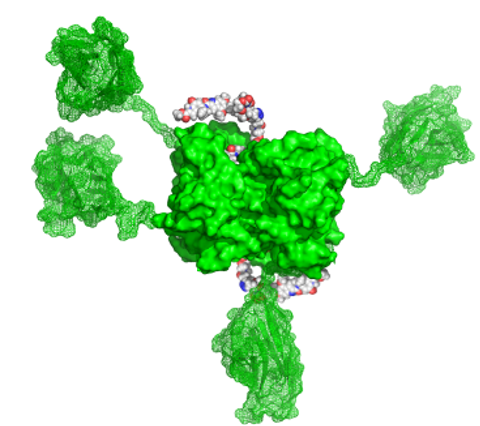
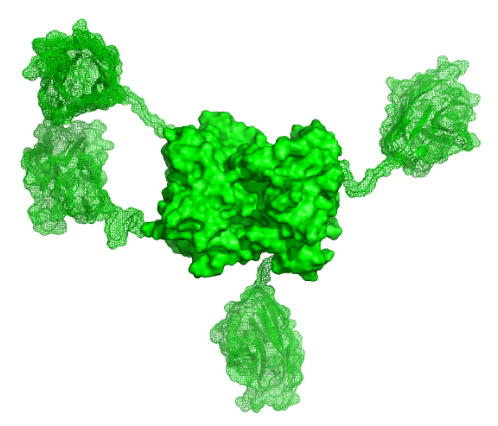
標的認識モジュール(低免疫原性ストレプトアビジン4量体 + VHH/Affibody)の立体構造
標的認識モジュール
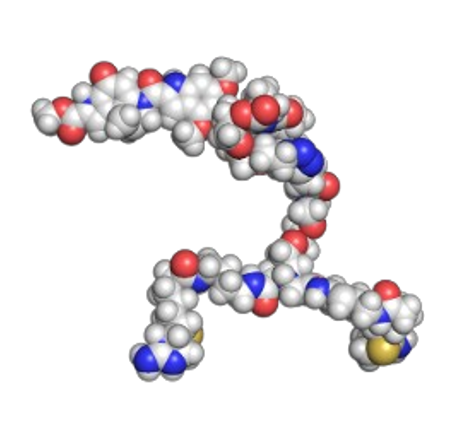
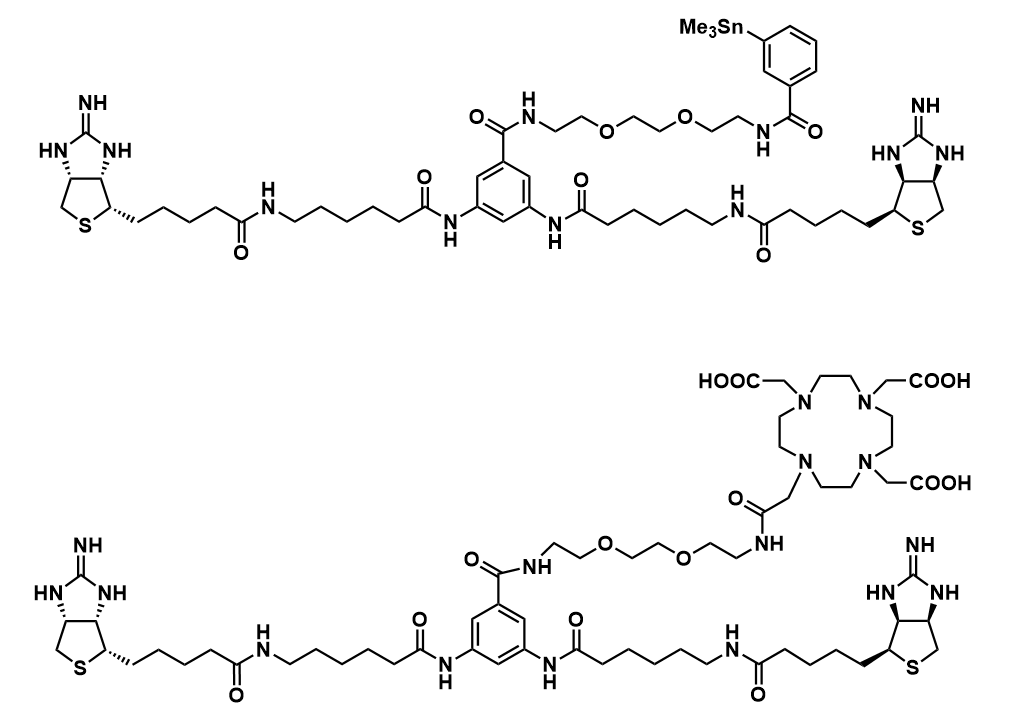
制がん剤ペイロードモジュールの分子構造(ビスイミノビオチンリンカー)
制がん剤ペイロードモジュール
AMDC(4量体に2分子のペイロードが非共有結合した完成体)の立体構造
AMDC
01

標的認識モジュール

VHH抗体 / Affibody

低免疫原性ストレプトアビジンユニットと抗体ミメティクスをリンカーで結合し、 強固な4量体構造を形成。4つの手でがん細胞表面の標的抗原を確実に捉えます。 分子量約100 kDaとIgGより小さく、腫瘍内部への高い浸透性を実現します。

  • 低免疫原性・高安定性の4量体構造
  • 高い腫瘍浸透性(~100 kDa)
  • 従来ADCと異なる血中動態
02

ペイロードモジュール

Chemo / Photo / Radio

化学合成により調製され、ビスイミノビオチンリンカーとクリック反応で 合成・ライブラリー化が可能。標的認識モジュールと組み合わせて、 多様なモダリティへプラグ&プレイ展開します。

  • 制がん剤(Duocarmycin 等)でDNAを直接損傷
  • 光増感剤で一重項酸素を発生させ破壊
  • 放射性核種で診断〜治療を一体化
03

精密な結合比率の規定

1 : 2 Assembly

ペイロードのアセンブリの「数」と「場所」を厳密に規定。 1つの低免疫原性4量体に対し、2つのペイロードモジュールが 表裏に特異的に非共有結合します。

  • 薬物送達の均一性を担保
  • 治療効果の再現性を最大化
  • 規定された結合様式
💊

制がん剤ペイロードモジュール Chemo

Duocarmycin 等の強力な薬剤を細胞内へ届け、DNAを直接損傷し死滅させます。

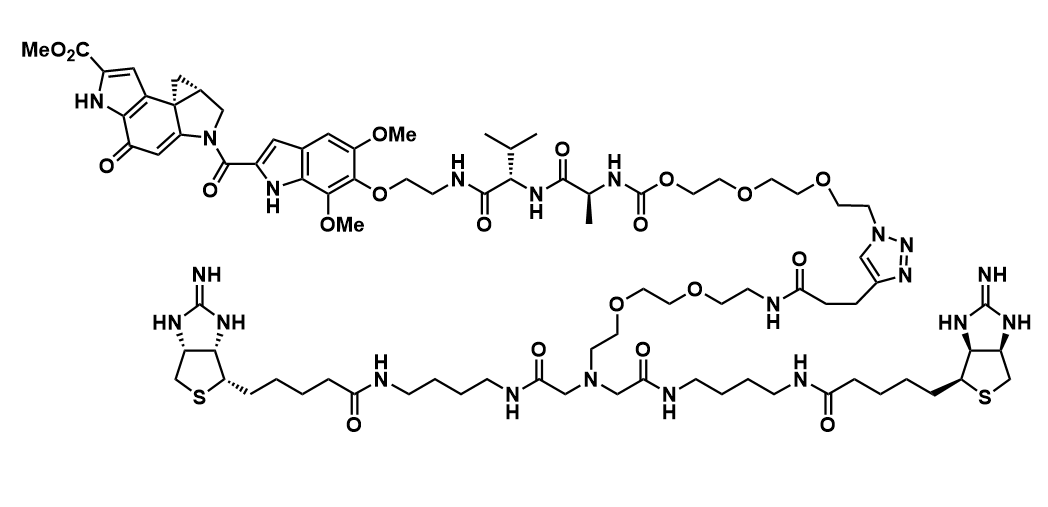
制がん剤ペイロードモジュール(Duocarmycin)の化学構造
☢️

放射性核種ペイロードモジュール Radio

64Cu・111In・89Zn による診断から、211At・225Ac・177Lu による治療まで、セラノスティクスを実現します。

放射性核種ペイロードモジュールの化学構造
💡

光増感剤ペイロードモジュール Photo

外部からの光エネルギーに反応する光増感剤で一重項酸素を発生させ、がん細胞を破壊します。

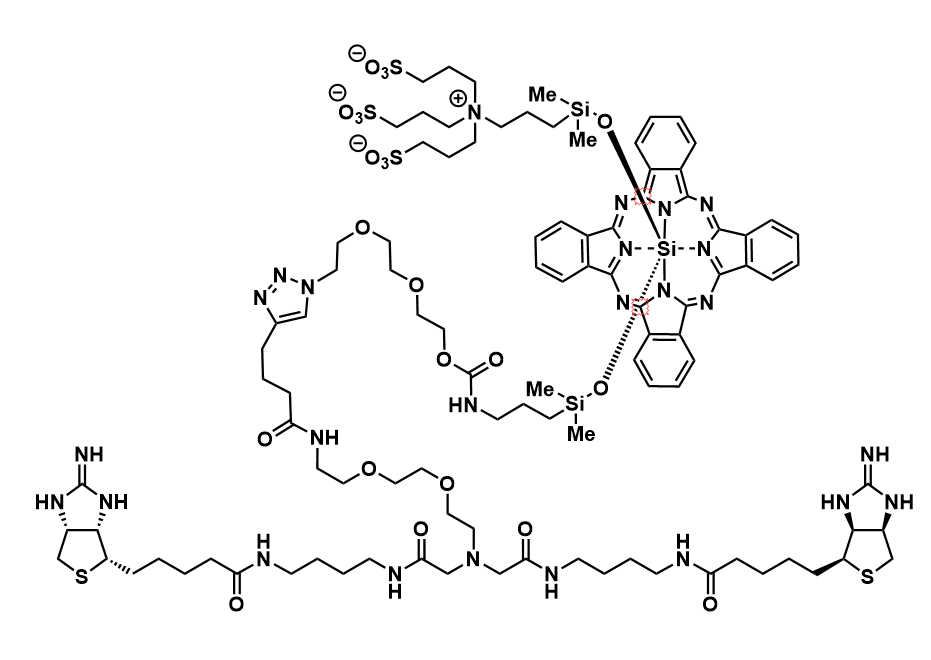
光増感剤ペイロードモジュール(SiPc)の化学構造

事業内容

AMDCプラットフォームを基盤に、自社創薬・試薬提供・パートナー連携を展開します。

🧪

Ax-SiPc 試薬

光増感剤を用いた研究用試薬を提供。アカデミア・企業の研究開発を支援します。

続きを読む →
🔬

モジュール型創薬アーキテクチャー

標的認識モジュールとペイロードモジュールを非共有結合で結びつける独自アセンブリ技術。

🤝

パートナー連携・CMC開発

AGC株式会社等のグローバルパートナーと連携し、商用製造体制(CMCプロセス)の確立を推進します。

開発パイプライン

HER2 を中心に複数の標的抗原・がん種へ展開。各プログラムの開発段階と 次のマイルストーンを示しています。

Theme code Sub-code 標的 / がん種 ペイロード 創薬 前臨床 P1 次のマイルストーン
CCI-01 HER2 / 乳房外パジェット 光増感剤 前臨床POC拡充・適応探索
CCI-02 01 HER2 / 乳房外パジェット Duocarmycin 前臨床パッケージ拡充
CCI-02 02 Duo-HER2 HER2 / 進行・転移性乳がん Duocarmycin GLP毒性・CMC → IND/CTN申請準備
CCI-02 03 HER2 / 卵巣がん Duocarmycin+ATR阻害剤 併用コンセプト前臨床
CCI-02 04 HER2 / 進行胃がん Duocarmycin リード最適化
CCI-02 05 HER2 / 大腸・肺がん Duocarmycin+抗HER2抗体薬 併用コンセプト検証
CCI-03 CD276 / 膵臓がん 等 光増感剤 標的バリデーション
CCI-04 Trop2 / 固形がん Duocarmycin 光増感剤 モダリティ選定
CCI-05 GPC3 / 肝臓がん 光増感剤 リード探索
CCI-06 CD82 / 血液がん Duocarmycin 放射性核種(α線) リード選定
完了
進行中

※ 進捗バー・マイルストーンは現時点の社内計画に基づく目安であり、進捗により変動します。各プログラムは前臨床以前の段階を含みます。

Partnership & Collaboration

前臨床から臨床へ。
今が最も重要な参画タイミングです。

リードプログラム「Duo-HER2」は AMED 採択・PMDA 相談済みで、前臨床試験が進行中です。 AMDCプラットフォームの技術ライセンス・共同研究・CMC パートナーシップなど、 幅広い形での連携をお待ちしています。

News & Strategic Milestones

事業

Duo-HER2 の新規モダリティ医薬品等薬事開発相談をPMDAと実施

AMEDスマートバイオ創薬等研究支援事業(代表研究者:金井求(東大・薬))の支援事業の一環として、Duo-HER2 の新規モダリティ医薬品等薬事開発相談をPMDAと実施しました。相談品目の概要を説明し、Duo-HER2の開発について相談と意見交換を行いました。

記事

CompleCure、乳がん対象に複雑なリンカーいらずのVHH抗体薬物複合体の開発目指す

日経バイオテク ベンチャー探訪

続きを読む →
プレスリリース

AGC株式会社とAMDC新薬の製法開発に関する契約を締結

続きを読む →
プレスリリース

大きくなったがんを消失させる抗体ミメティクスの制癌剤結合薬の製造方法を開発(東京大学先端科学技術研究センター)

続きを読む →
プレスリリース

再発した乳がんを完全消失させる実験に成功(東京大学先端科学技術研究センター)

続きを読む →
プレスリリース

身体への負担が少ない抗がん剤「局所抗体ミメティクス結合薬物」の開発に成功(東京大学先端科学技術研究センター)

続きを読む →

学会・セミナー情報

CompleCure はAMDC技術の最新成果を、国内外の学会・セミナーで積極的に発信しています。

2026.10.19–21 基調講演

Antibody Engineering & Therapeutic Asia 2026 in Kyoto

抗体エンジニアリング・治療学会アジア大会2026

講演者:土屋 政幸 代表取締役社長

講演タイトル:Beyond conventional ADCs — A modular antibody-mimetic drug conjugate platform for flexible cancer targeting

イベント詳細 →
2026.09.24–26 ポスター発表

第85回 日本癌学会学術集会

京都国際会議場

ポスター発表 2演題:杉山CTO/白鳥 主任研究員

イベント詳細 →
2026.10.22–24 ポスター発表

第64回 日本癌治療学会学術集会2026

神戸国際会議場

ポスター発表:杉山CTO

イベント詳細 →
2025.11.05 プレゼン

ダイアログ社 Webinar『NEXT-GENERATION ANTIBODY-BASED MODALITIES』

講演者:土屋 政幸

新規創薬モダリティの開発と挑戦:バイオと合成化合物の新たな複合製剤

イベント詳細 →
2025.07.28 プレゼン

日経バイオテクDays 創薬イノベーションの未来展望

~モダリティの最新動向から標的探索の新アプローチまで~

講演者:土屋 政幸

イベント詳細 →
2025.06.19 プレゼン

第25回 日本蛋白質科学年会 ランチョンセミナー

講演者:土屋 政幸

新規モダリティの開発と挑戦:バイオと合成化合物の新たな複合製剤

イベント詳細 →
2025.05.13 ポスター発表

PEGS Boston — Protein & Antibody Engineering Summit

講演者:杉山 暁

Development of a New ADC Platform Designed by Antibody Mimetic Drug Conjugate

イベント詳細 →
2025.04.07 商標登録

特許庁より商標登録証を受領

登録第6916414号『Targeted Combination Therapy』

実行体制

経営・技術・財務を中核とする経営陣に加え、創薬・化学・臨床の各領域で第一線の研究者・臨床医の助言を得ながら開発を推進しています。

CEO / 代表取締役社長

土屋 政幸

医学博士

抗体医薬のパイオニア。中外製薬時代に G-CSF(ノイトロジン)の世界初の cDNA クローニング、抗IL-6受容体抗体のヒト化(ブロックバスター「アクテムラ」)など2つの自社医薬品の創出を主導。研究本部長級を歴任し、ロシュとの経営統合プロジェクトにも参画。探索研究から薬事・事業化までを通貫する経験を持つ。

CTO / 取締役

杉山 暁

博士(学術)

15年にわたりAMDC研究を最前線で行う。AMDCプラットフォームの研究開発を統括し、PEGS Boston・日本癌学会等で研究成果を発表。

CFO / 取締役

中井 正矩

コーポレート全般を統括し、研究開発を管理面から支える。

Advisors / 科学顧問

日本を代表する研究者・臨床医

AMDCの基盤技術は、計算科学・分子動力学で国内を代表する研究者らとの長年の共同研究から誕生しました。創薬・化学・臨床の各領域で、日本を代表する多数の研究者・臨床医の先生方に科学的助言をいただいています。

※ 役職・所属は本ページ作成時点の情報です。

企業情報

代表ご挨拶 / Message

進行がん患者様の完治を目指す治療薬を

CompleCureは、「進行がん患者様の完治を目指す治療薬を」というビジョンを掲げ、がん治療の革新に挑戦する創薬スタートアップ企業です。当社の基盤技術であるAMDC(Antibody Mimetic Drug Conjugate)は、先進の計算科学・分子動力学で国内を代表する研究者たちとともに、長年にわたる研究成果として誕生しました。スーパーコンピュータを活用した技術開発により、従来の治療法を超える治療効果と安全性の両立を目指し、がん治療の未来を切り拓くことを目指しています。

私たちの使命は、難治性・進行性のがんや、既存の治療が効かなくなった患者様に対し、希望を持てる治療法をお届けすることです。最新の抗体ミメティック技術を駆使し、光免疫療法や合成致死誘導といった新たな治療アプローチに挑んでいます。

また、研究開発に留まらず、製薬・医療業界の各パートナーとの連携を積極的に推進し、創薬エコシステムの加速を図っています。AGC様との製造技術開発もその一環であり、複数のパートナーと技術と知見を結集することで、より多くの患者様に迅速に治療を届けることを目指します。

CompleCureは、患者様とそのご家族に寄り添う心を大切にし、がん治療の未来を切り拓く存在であり続けたいと考えています。私たちの挑戦は始まったばかりです。今後ともご支援・ご指導のほど、何卒よろしくお願い申し上げます。

代表取締役社長 土屋 政幸

社名 株式会社 CompleCure
代表者 代表取締役社長 土屋 政幸
所在地 〒151-0053
東京都渋谷区代々木五丁目59番5号
事業内容 モジュール型創薬アーキテクチャーを活用した医薬品研究開発、試薬の提供
コア技術 AMDC プラットフォーム / Cupid-Psyche system / Targeted Combination Therapy™
技術の原点 東京大学先端科学技術研究センター発
分子動力学抗体創薬技術研究組合(MDADD)
共同研究先 東京大学、東北大学、千葉大学、琉球大学、福島県立医科大学、星薬科大学ほか

私たちの強み

🧬

15年以上の計算科学

数千万原子レベルの京スーパーコンピュータによるシミュレーション研究に裏打ちされた超高精度分子設計。

🏛️

国家プロジェクトの支援

FIRST・AMED 等、厳格な審査を経た国家プロジェクトの支援を継続的に獲得。

📜

特許ポートフォリオ

アーキテクチャー・ペイロード・セラノスティクスにわたる強固な特許網。

🌐

グローバル連携

AGC社等のパートナーとともに商用製造体制を確立し、臨床開発を加速。

CompleCure と、次の一手を。

AMDCプラットフォームの可能性を一緒に広げていただける企業・研究機関・投資家の皆様からのご連絡をお待ちしています。

AMED 採択済み スマートバイオ創薬等研究支援事業(2024年)
PMDA 相談実施 Duo-HER2 の薬事開発相談(2026年)
AGC と連携 グローバル製薬パートナーとCMC開発中
🔬

共同研究・ライセンス

AMDCプラットフォームの技術ライセンスや、アカデミア・企業との共同研究契約についてご相談ください。東大・東北大・千葉大など複数の大学と連携実績があります。

🤝

VC・投資家・事業提携

Duo-HER2 の前臨床→臨床移行期への投資参画、AMDCプラットフォームのライセンスアウト・共同開発など、幅広い形でのパートナーシップを歓迎します。まずはお気軽にご連絡ください。

🧑‍🔬

採用・インターン

生命科学・化学・情報科学のバックグラウンドをお持ちの方、大歓迎です。創薬の最前線で「進行がんに新たな治療選択肢を創る」という目標に向けて一緒に挑戦しましょう。

まずはフォームよりお気軽にご連絡ください。

お問い合わせフォームへ →

Modular Therapeutic Architecture · AMDC

Creating New Treatment Options for Patients with
Treatment-Resistant Advanced Cancers

A modular targeted therapeutics platform designed to address resistance beyond conventional ADCs.

A substantial unmet medical need remains for patients with advanced cancers that no longer respond to existing anti-HER2 agents and other therapies. CompleCure's Antibody Mimetic Drug Conjugate (AMDC) is a modular drug-delivery platform that builds a computationally optimized antibody mimetic as the targeting module together with a payload module through a simple non-covalent "mix-and-go" assembly process.

Built on more than 15 years of computational science research originating at the University of Tokyo, we are advancing our lead development candidate, "Duo-HER2," in Preclinical development.

Duo-HER2 Lead Asset (Preclinical Stage)
10+ Programs Across Multiple Targets and Payload Modalities
3 Backed by Competitive National Grants

Investment Snapshot

A concise overview so you can grasp the full picture of our business at a glance.

Lead Asset Duo-HER2 (CCI-02 series) An AMDC candidate pairing an anti-HER2 antibody mimetic with a Duocarmycin payload
Stage Preclinical (development toward IND/CTN filing) GLP toxicology studies, CMC development, and lead optimization underway
Target indication HER2-positive advanced/metastatic breast cancer Positioned for sequential therapy after existing anti-HER2 agents such as T-DM1 and T-DXd, with room to expand to other tumor types
Key validation Preclinical POC / national project award Tumor regression reported in a preclinical (mouse) model. AMED award secured and PMDA regulatory (development) consultation conducted
CMC partner AGC Inc. Signed a manufacturing process development agreement for a novel AMDC drug; jointly developing the commercial manufacturing process
IP Proprietary and jointly filed patents 10 patents spanning the architecture, payloads, and theranostics, registered or under prosecution in Japan, the U.S., Europe, and China. The trademark "Targeted Combination Therapy" (Reg. No. 6916414) is not included in this count.
Next milestone Complete GLP toxicology and CMC toward IND/CTN filing Aiming to finalize lead optimization and the preclinical package
Fundraising / Use of proceeds Preparing a financing round Primary use of proceeds: (1) GLP toxicology studies, (2) CMC and manufacturing scale-up, (3) completion of lead optimization and preclinical work. We are accelerating development toward clinical entry of the lead asset.

Why Now?

📈

HER2 ADC market >$10B and growing, with no clear successor after T-DXd

⚠️

Growing unmet medical need for patients who progress after T-DXd failure

🔬

Modular platform scalable beyond HER2 across multiple tumor types

💊

Multiple payload modalities (chemo, photo, radio) validated in preclinical models

* The information on this page reflects the status of research and development at the preclinical stage and does not guarantee efficacy, safety, or regulatory approval.

Three Pillars to Create
New Treatment Options for Advanced Cancer

Because conventional ADCs conjugate the drug to the antibody through covalent bonds, variability in the DAR (drug-to-antibody ratio) can contribute to side effects and inconsistent potency. CompleCure's Antibody Mimetic Drug Conjugate (AMDC), a modular targeted therapeutic platform, is designed to address this structural challenge through non-covalent assembly.

01

An Innovative DDS That Delivers Drugs Precisely on Target

AMDC is a drug-delivery system (DDS) designed to deliver cytotoxic agents selectively to targeted cancer cells. A targeting module that recognizes the cancer antigen and a payload module that carries the therapeutic effect are combined non-covalently and formulated as a complex with a uniform 1:2 DAR. By reducing the quality and manufacturing challenges of conventional ADCs, it delivers a new, next-generation ADC.

02

Engineered Antibody Mimetics, Designed by AI

We have entered an era in which antibody molecules can be designed and optimized with AI. The AMDC targeting module can incorporate such AI-designed engineered antibody mimetics (VHH antibodies, Affibody molecules, etc.). This removes the need to rely on large, native antibodies as in conventional ADC development, achieving high tumor penetration with a compact ~100 kDa structure and efficiently generating the optimal molecule for each cancer antigen.

03

Diverse Payloads, Selected to Match the Disease

AMDC allows the therapeutic payload to be freely interchanged. CompleCure is focused on three: (1) the photosensitizer AxSiPc (proprietary, patented), which exerts anti-tumor activity through photoimmunotherapy; (2) Duocarmycin, a potent anticancer agent whose activity is enhanced by inducing synthetic lethality in combination with an ATR inhibitor; and (3) radionuclides that make safer use of well-established radioactive isotopes. By flexibly selecting among them to match each patient's disease, we enable personalized treatment.

The Lineage of AMDC R&D and
Acceleration Toward Clinical Development

CompleCure's technology base traces back to molecular-dynamics simulation research conducted on the K supercomputer at the scale of tens of millions of atoms, under the national project "Molecular Dynamics Antibody Drug Discovery (MDADD)" launched in 2010.

Our proprietary modular drug-discovery platform has been built over more than 15 years through computational-science expertise, the support of rigorous national projects, and a solid patent portfolio.

  1. 2010 – 2014

    Core Technology Development

    Selected for the Cabinet Office's "Funding Program for World-Leading Innovative R&D on Science and Technology (FIRST)." The Molecular Dynamics Antibody Drug Discovery research consortium was established, centered on the Research Center for Advanced Science and Technology (RCAST) at the University of Tokyo, with participation from Osaka University, Chugai Pharmaceutical, and Fujifilm. Ultra-high-precision molecular design, such as "low-immunogenicity streptavidin," was established.

  2. 2014 – 2018

    Radionuclide Payloads

    Successfully developed payload modules using metallic radionuclides (64Cu, 111In) and the next-generation alpha-emitter 211At. Core technology leading to theranostics—integrating diagnosis and therapy—was firmly secured by patents.

  3. 2019 – 2020

    Architecture Established

    As the foundational patents on VHH antibodies and Affibody molecules expired, full-scale design of the AMDC (Antibody-Molecule Drug Conjugate) began. Combinatorial manufacturing of diverse VHH and other binders was demonstrated, and a patent network was established covering the modular drug-discovery architecture as well as photosensitizer and anticancer (duocarmycin: Duo) payloads.

  4. 2024 – 2028

    Acceleration Toward Clinical Development

    Following rigorous review, our highest-priority lead program, "Duo-HER2," was selected for the "Smart-Bio Drug Discovery Research Support Program" of AMED (the Japan Agency for Medical Research and Development). Clinical development of the next-generation ADC (AMDC) technology, together with CMC process development (establishing a commercial manufacturing system) through collaboration with global partners such as AGC, is advancing rapidly.

Why AMDC, Why Now

At a moment when the antibody-therapeutics market is undergoing structural change, CompleCure is positioned to get ahead of the market with a next-generation platform.

01

Market

A market shift toward next-generation modalities

As the foundational patents on monoclonal antibodies expire one after another, biosimilar competition is intensifying, and major pharmaceutical companies are shifting development resources toward ADCs and next-generation conjugates. CompleCure has been preparing for this shift for more than 15 years.

02

Platform

Multiple assets from one platform, with high capital efficiency

Because the targeting module and the payload module can be swapped plug-and-play, the cost of expanding to new targets is contained. From a single platform, we are advancing 6 targets and more than 10 programs, including HER2, CD276, Trop2, and GPC3.

03

Lead Asset

Duo-HER2 / unmet needs in sequential therapy for advanced breast cancer

A candidate aimed at sequential therapy for patients whose disease no longer responds to existing anti-HER2 agents (T-DM1, T-DXd, etc.). We have confirmed a promising profile in preclinical models and are advancing development that aims to be best in class (preclinical stage). AMED award, PMDA regulatory consultation, and CMC development with AGC are underway.

04

Partnership & Exit

Parallel paths: out-licensing / co-development / M&A

In addition to out-licensing the lead asset, target-specific licensing or co-development of the AMDC platform itself are options under consideration. With large partnerships and acquisitions active in the ADC field, we are advancing development with multiple exit scenarios in view.

15+ Years of R&D
10+ Development pipelines
3 Competitive National Grants
6 Target antigens

For inquiries about investment or partnership, please feel free to contact us.
We will prepare more detailed materials according to your area of interest.

Antibody Mimetic Drug Conjugate (AMDC)

The "targeting module" and the "payload module" assemble non-covalently—simply by mixing, with no chemical reaction. They expand plug-and-play into diverse modalities.

Conventional ADC

Covalent
antibody-drug conjugate

  • Because the drug is chemically conjugated to the antibody, the DAR (drug-to-antibody ratio) varies from molecule to molecule
  • Requires complex purification, making scale-up difficult
  • Antibodies (~150 kDa) are large, so penetration into the tumor interior tends to be insufficient
  • A new antibody and linker must be designed each time the target changes
VS

CompleCure's AMDC

Non-covalent
modular drug discovery

  • A bis-iminobiotin–streptavidin non-covalent bond consistently achieves a uniform 1:2 DAR
  • No chemical reaction—assembly completes simply by mixing, greatly simplifying the manufacturing process
  • A compact ~100 kDa tetrameric structure ensures high tumor penetration
  • Targeting and payload are independently interchangeable—plug-and-play expansion across many tumor types
Targeting module

Protein

High-specificity VHH / Affibody

+
Payload module

Chemical compound

Anti-tumor agent / photosensitizer / radionuclide

=
AMDC

Assembly completed by non-covalent binding

No chemical reaction—just mix

3D structure of the targeting module (low-immunogenicity streptavidin tetramer + VHH/Affibody)
Targeting module
Molecular structure of the anticancer payload module (bis-iminobiotin linker)
Anticancer payload module
3D structure of the completed AMDC (two payloads non-covalently bound to the tetramer)
AMDC
01

Targeting Module

VHH antibody / Affibody

A low-immunogenicity streptavidin unit is joined to antibody mimetics by linkers, forming a robust tetrameric structure. With four "hands," it reliably captures the target antigen on the cancer-cell surface. At about 100 kDa—smaller than IgG—it achieves high penetration into the tumor interior.

  • Low-immunogenicity, highly stable tetrameric structure
  • High tumor penetration (~100 kDa)
  • Pharmacokinetics distinct from conventional ADCs
02

Payload Module

Chemo / Photo / Radio

Prepared by chemical synthesis, it can be synthesized and assembled into libraries through a click reaction with a bis-iminobiotin linker. Combined with the targeting module, it expands plug-and-play into diverse modalities.

  • Anticancer agents (e.g., Duocarmycin) directly damage DNA
  • Photosensitizers generate singlet oxygen to destroy cells
  • Radionuclides integrate diagnosis and therapy
03

A Precisely Defined Binding Ratio

1 : 2 Assembly

The "number" and "location" of payload assembly are strictly defined. For each low-immunogenicity tetramer, two payload modules bind non-covalently and specifically on opposite faces.

  • Ensures uniform drug delivery
  • Maximizes reproducibility of therapeutic effect
  • A defined mode of binding
💊

Anticancer payload module Chemo

Delivers potent agents such as Duocarmycin into cells, directly damaging DNA to kill them.

Chemical structure of the anticancer payload module (Duocarmycin)
☢️

Radionuclide payload module Radio

From diagnosis with 64Cu, 111In, and 89Zn to therapy with 211At, 225Ac, and 177Lu, it enables theranostics.

Chemical structure of the radionuclide payload module
💡

Photosensitizer payload module Photo

A photosensitizer that responds to external light energy generates singlet oxygen to destroy cancer cells.

Chemical structure of the photosensitizer payload module (SiPc)

Our Business

Building on the AMDC platform, we pursue in-house drug discovery, reagent supply, and partner collaboration.

🧪

Ax-SiPc Reagent

We supply research-use reagents based on photosensitizers, supporting R&D at academia and companies.

Read more →
🔬

Modular Drug-Discovery Architecture

Our proprietary assembly technology links the targeting module and the payload module non-covalently.

🤝

Partner Collaboration & CMC Development

Working with global partners such as AGC Inc., we advance the establishment of a commercial manufacturing system (CMC process).

Development Pipeline

Centered on HER2 and expanding across multiple target antigens and tumor types. We show each program's development stage and next milestone.

Theme code Sub-code Target / Tumor type Payload Discovery Preclinical P1 Next milestone
CCI-01 HER2 / extramammary Paget's disease Photosensitizer Expand preclinical POC; explore indications
CCI-02 01 HER2 / extramammary Paget's disease Duocarmycin Expand preclinical package
CCI-02 02 Duo-HER2 HER2 / advanced/metastatic breast cancer Duocarmycin GLP tox & CMC → prepare IND/CTN filing
CCI-02 03 HER2 / ovarian cancer Duocarmycin + ATR inhibitor Preclinical combination concept
CCI-02 04 HER2 / advanced gastric cancer Duocarmycin Lead optimization
CCI-02 05 HER2 / colorectal & lung cancer Duocarmycin + anti-HER2 antibody Validate combination concept
CCI-03 CD276 / pancreatic cancer, etc. Photosensitizer Target validation
CCI-04 Trop2 / solid tumors Duocarmycin Photosensitizer Modality selection
CCI-05 GPC3 / liver cancer Photosensitizer Lead identification
CCI-06 CD82 / hematologic cancer Duocarmycin Radionuclide (alpha) Lead selection
Completed
In progress

* Progress bars and milestones are estimates based on current internal plans and may change as work progresses. Some programs are at stages prior to preclinical.

Partnership & Collaboration

From Preclinical to Clinical.
Now Is the Most Important Time to Get Involved.

Our lead program, "Duo-HER2," has received an AMED award and completed PMDA consultation, and preclinical studies are underway. We welcome collaboration in many forms—technology licensing of the AMDC platform, joint research, CMC partnerships, and more.

News & Strategic Milestones

Business

PMDA regulatory (development) consultation conducted for Duo-HER2 as a novel-modality medicinal product

As part of the support under AMED's Smart-Bio Drug Discovery Research Support Program (Principal Investigator: Prof. Motomu Kanai, Graduate School of Pharmaceutical Sciences, the University of Tokyo), we conducted a regulatory (development) consultation with the PMDA for Duo-HER2 as a novel-modality medicinal product. We presented an overview of the consultation item and exchanged views on the development of Duo-HER2.

Article

CompleCure aims to develop a VHH antibody-drug conjugate without complex linkers for breast cancer

Nikkei Biotechnology — Venture Visit

Read more →
Press release

Signed an agreement with AGC Inc. on manufacturing process development for a novel AMDC drug

Read more →
Press release

Developed a manufacturing method for an antibody-mimetic anticancer-drug conjugate that eliminates enlarged tumors (RCAST, the University of Tokyo)

Read more →
Press release

Succeeded in an experiment that completely eliminated recurrent breast cancer (RCAST, the University of Tokyo)

Read more →
Press release

Successfully developed a low-burden anticancer drug, a "local antibody-mimetic drug conjugate" (RCAST, the University of Tokyo)

Read more →

Conferences & Seminars

CompleCure actively shares the latest results of its AMDC technology at conferences and seminars in Japan and abroad.

2026.10.19–21 Keynote

Antibody Engineering & Therapeutic Asia 2026 in Kyoto

Speaker: Masayuki Tsuchiya, President & CEO

Talk title: Beyond conventional ADCs — A modular antibody-mimetic drug conjugate platform for flexible cancer targeting

Event details →
2026.09.24–26 Poster

85th Annual Meeting of the Japanese Cancer Association

Kyoto International Conference Center

Two poster presentations: CTO Sugiyama / Senior Researcher Shiratori

Event details →
2026.10.22–24 Poster

64th Annual Meeting of the Japan Society of Clinical Oncology 2026

Kobe International Conference Center

Poster presentation: CTO Sugiyama

Event details →
2025.11.05 Presentation

Dialogue Inc. Webinar "NEXT-GENERATION ANTIBODY-BASED MODALITIES"

Speaker: Masayuki Tsuchiya

Developing and taking on new drug-discovery modalities: a novel complex of biologics and synthetic compounds

Event details →
2025.07.28 Presentation

Nikkei Biotechnology Days — Future Outlook for Drug-Discovery Innovation

From the latest modality trends to new approaches in target discovery

Speaker: Masayuki Tsuchiya

Event details →
2025.06.19 Presentation

25th Annual Meeting of the Protein Science Society of Japan — Luncheon Seminar

Speaker: Masayuki Tsuchiya

Developing and taking on new modalities: a novel complex of biologics and synthetic compounds

Event details →
2025.05.13 Poster

PEGS Boston — Protein & Antibody Engineering Summit

Speaker: Akira Sugiyama

Development of a New ADC Platform Designed by Antibody Mimetic Drug Conjugate

Event details →
2025.04.07 Trademark

Received a trademark registration certificate from the Japan Patent Office

Reg. No. 6916414 "Targeted Combination Therapy"

Our Team

In addition to a management team centered on business, technology, and finance, we advance development with advice from leading researchers and clinicians across drug discovery, chemistry, and clinical medicine.

CEO / President

Masayuki Tsuchiya

Ph.D. (Medicine)

A pioneer of antibody therapeutics. At Chugai Pharmaceutical, he led the world's first cDNA cloning of G-CSF (Neutrogin) and the humanization of an anti-IL-6 receptor antibody (the blockbuster "Actemra"), driving the creation of two in-house drugs. He held positions at the head-of-research level and took part in the management-integration project with Roche. He brings experience spanning exploratory research through regulatory affairs and commercialization.

CTO / Director

Akira Sugiyama

Ph.D.

Has worked at the forefront of AMDC research for 15 years. He oversees R&D of the AMDC platform and has presented results at PEGS Boston, the Japanese Cancer Association, and elsewhere.

CFO / Director

Masanori Nakai

Oversees corporate functions across the board and supports R&D on the administrative side.

Advisors / Scientific advisors

Leading researchers and clinicians in Japan

AMDC's foundational technology was born from years of joint research with researchers who lead Japan in computational science and molecular dynamics. Across drug discovery, chemistry, and clinical medicine, we receive scientific advice from numerous leading researchers and clinicians in Japan.

* Titles and affiliations are current as of the creation of this page.

Corporate Information

Message from the CEO

Developing Therapeutics to Cure Advanced Cancer

CompleCure is a drug-discovery startup challenging the innovation of cancer treatment under the vision of "therapeutics aiming for the cure of patients with advanced cancer." Our core technology, the AMDC (Antibody Mimetic Drug Conjugate), was born as the fruit of many years of research together with researchers who lead Japan in advanced computational science and molecular dynamics. Through technology development that leverages supercomputers, we aim to achieve both efficacy and safety beyond conventional therapies and to pioneer the future of cancer treatment.

Our mission is to deliver hope-giving therapies to patients with refractory or advanced cancers and to those for whom existing treatments have stopped working. Drawing on the latest antibody-mimetic technology, we are taking on new therapeutic approaches such as photoimmunotherapy and the induction of synthetic lethality.

Beyond R&D, we actively promote collaboration with partners across the pharmaceutical and medical industries to accelerate the drug-discovery ecosystem. Our manufacturing-technology development with AGC is one example; by bringing together technology and expertise with multiple partners, we aim to deliver treatments to more patients faster.

CompleCure cherishes a spirit of standing close to patients and their families, and we strive to remain an organization that pioneers the future of cancer treatment. Our challenge has only just begun. We sincerely appreciate your continued support and guidance.

Masayuki Tsuchiya, President & CEO
Company name CompleCure, Inc.
Representative Masayuki Tsuchiya, President & CEO
Location 5-59-5 Yoyogi, Shibuya-ku,
Tokyo 151-0053, Japan
Business R&D of pharmaceuticals and supply of reagents, leveraging a modular drug-discovery architecture
Core technology AMDC platform / Cupid-Psyche system / Targeted Combination Therapy™
Technology origin Born from RCAST, the University of Tokyo
Molecular Dynamics Antibody Drug Discovery (MDADD) consortium
Research collaborators University of Tokyo, Tohoku University, Chiba University, University of the Ryukyus, Fukushima Medical University, Hoshi University, and others

Our Strengths

🧬

15+ years of computational science

Ultra-high-precision molecular design, backed by simulation research at the scale of tens of millions of atoms on the K supercomputer.

🏛️

Support of national projects

Continuously secured support from rigorously reviewed national projects such as FIRST and AMED.

📜

Patent portfolio

A robust patent network spanning the architecture, payloads, and theranostics.

🌐

Global collaboration

Establishing a commercial manufacturing system with partners such as AGC to accelerate clinical development.

Make your next move with CompleCure.

We look forward to hearing from companies, research institutions, and investors who can help expand the potential of the AMDC platform together.

AMED awarded Smart-Bio Drug Discovery Research Support Program (2024)
PMDA consultation held Regulatory (development) consultation for Duo-HER2 (2026)
Collaboration with AGC CMC development with a global pharmaceutical partner
🔬

Joint Research & Licensing

Please reach out about technology licensing of the AMDC platform or joint-research agreements with academia and companies. We have a track record of collaboration with several universities, including the University of Tokyo, Tohoku University, and Chiba University.

🤝

VCs, Investors & Business Alliances

We welcome partnerships in many forms—investment in Duo-HER2's preclinical-to-clinical transition, out-licensing or co-development of the AMDC platform, and more. Please feel free to reach out.

🧑‍🔬

Careers & Internships

If you have a background in life sciences, chemistry, or information science, we would love to hear from you. Join us at the frontier of drug discovery toward our goal of "creating new treatment options for advanced cancer."

Please feel free to reach out first via the form.

Go to the contact form →